
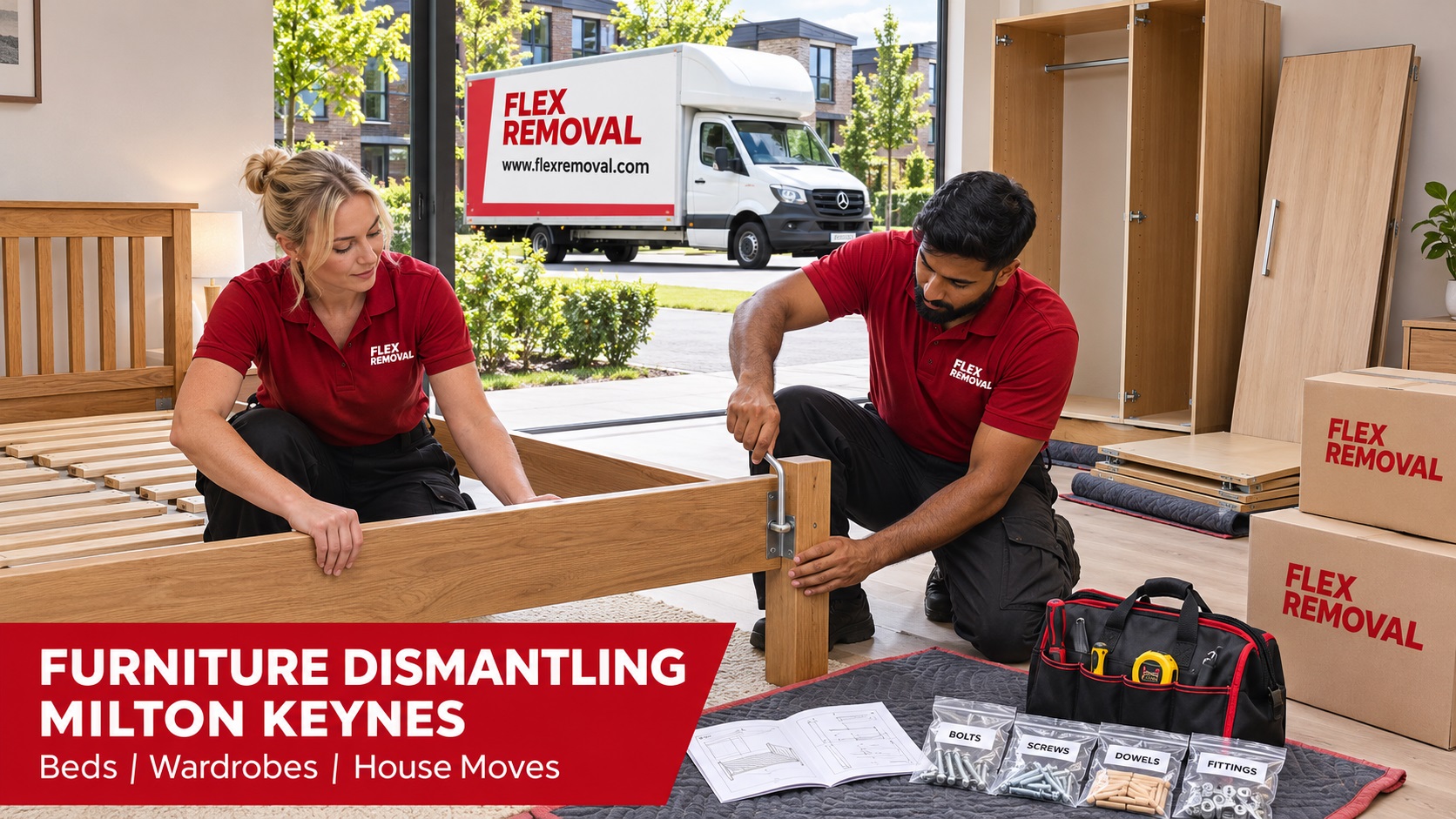
Furniture dismantling in Milton Keynes should be planned around the individual item. Some beds separate easily using their original fittings. Other furniture has glued joints, worn boards or repairs that make dismantling more complicated. The right decision protects the furniture while making collection and delivery more practical.
Flex Removal Ltd can discuss furniture transport, dismantling and reassembly as part of your moving requirements. This guide explains how to assess your belongings, prepare useful information and agree the work before moving day. It covers household furniture as well as desks and storage units used in a home office.
Start with two questions: can the item pass through both properties in its current form, and can it be safely dismantled if necessary? Answering those questions early helps you avoid paying to transport furniture that cannot be installed where you want it.
DISCOVER MORE ABOUT FLEX REMOVAL LTD
When furniture needs dismantling before a move
Dismantling may be appropriate when an item is too large for a doorway, too awkward for a staircase turn or impractical to handle as one piece. It can also make some items easier to protect during transport. The decision depends on design, condition and the route through each property.
Do not assume that dismantling always saves time or money. Taking a complicated wardrobe apart and rebuilding it can require more work than transporting it assembled. If access is generous and the item is structurally suitable, moving it intact may be the better option.
Equally, leaving everything assembled until the vehicle arrives can create avoidable delays. Make a list of large beds, wardrobes, tables and desks before requesting a quote. Photograph the items and any narrow access points so your movers can identify what needs further assessment.
Flex Removal’s Milton Keynes service information provides a starting point for the wider move. Explain which furniture tasks are required alongside transport so they can be considered together.
FOR HEAVY MOVE, OUR PARTNER WWW.ABRAHAMLOGISTICS.COM
Measure furniture and access before choosing the method
Record the furniture’s external dimensions, including projecting feet, handles, headboards and tops. Where parts detach, note their separate dimensions if known. This helps identify items whose access problems can be resolved with a small adjustment, such as removing detachable feet.
Check the full route at collection and delivery. Doorways, hallway turns, stairs, landings and room entrances all matter. A large bed frame may leave the original bedroom easily but be difficult to manoeuvre into a loft room at the destination.
Measurements should be realistic and clearly described. State whether a doorway measurement includes the available opening with the door in place. If a floor plan is approximate, say so. Uncertain measurements should prompt a closer look rather than an optimistic assumption.
Also measure the intended space in the new room. Furniture that fits the property can still be unsuitable for the layout. Leave room to open drawers and doors and to use the room comfortably. Transport is only one part of making the furniture work in your next home.
MORE BLOGS AND INFORMATION ABOUT HOUSE MOVES UK
Bed dismantling and reassembly
Beds vary considerably. A simple metal frame, a timber frame, a divan base and an ottoman storage bed need different handling. Tell the team the bed type, size and any known issues, and provide a photograph of the assembled frame.
For beds with moving mechanisms, adjustable sections or electrical components, the manufacturer’s instructions are particularly useful. Do not improvise work on unfamiliar mechanisms. Ask whether the task falls within the agreed service or needs a specialist assessment.
Empty storage compartments before the appointment unless an alternative has been specifically agreed. Keep bedding separate, and identify the mattress so it can be protected and delivered to the correct room. Loose contents inside a bed can complicate handling and conceal damage.
If the bed must be ready on the first evening, say so when planning the sequence. Allow enough space in the bedroom for reassembly and keep unrelated boxes elsewhere until the frame is complete. Check that all sections and fittings have arrived before the crew leaves.
Wardrobe dismantling and the condition of flat pack furniture
Wardrobes can be challenging because they combine height, weight and large panels. Some were assembled inside a room and cannot leave through the door without being taken apart. Others have backs, runners or joints that may not tolerate repeated disassembly well.
Photograph the inside and outside, including any damaged corners or loose fittings. Explain whether the wardrobe has already been moved or repaired. These details help the team assess whether dismantling is reasonable and what limitations should be discussed.
Sliding-door wardrobes need particular care because panels, tracks and mirrored doors may require different protection. Identify each section and keep the original instructions if available. Avoid removing a large door yourself unless you have the appropriate knowledge and assistance.
Built-in furniture is a separate matter from freestanding furniture. It may be fixed to the property or tailored to a particular wall. Confirm ownership, suitability for removal and the need for a relevant tradesperson before including fitted units in a standard moving booking.
Dining tables, desks and modular furniture
A dining table with removable legs may be easier to carry and protect once the legs are separated. However, some tables have delicate veneers, extension mechanisms or heavy stone and glass tops. Describe the materials and construction rather than simply writing “one table” on the inventory.
Home-office desks may have cable trays, monitor arms and attached storage. Photograph the setup before disconnecting accessories and label cables separately. The furniture plan should distinguish moving the desk from setting up computers, networking or other technical equipment.
For modular units, identify the arrangement you want at the destination. A shelving system assembled in a different configuration may need additional fittings or more time. Discuss that before the move rather than expecting a new design to be included automatically.
Where an item is unusually valuable, fragile or heavy, request an individual assessment. A suitable packing and handling method should be agreed for that item. A standard approach that works for an ordinary desk may be inappropriate for a designer table or antique cabinet.
An inventory that helps movers assess the work
| Furniture item | Useful details | Work to confirm |
| Bed | Frame type, size and storage mechanism | Dismantling, mattress handling and rebuilding |
| Wardrobe | Dimensions, door type and condition | Suitability for taking apart and reassembly |
| Dining table | Top material and detachable sections | Protection and handling of separate parts |
| Desk | Size, attachments and cable management | Furniture work and responsibility for IT |
| Shelving | Freestanding or fitted, unit configuration | Removal method and destination layout |
| Specialist item | Weight, value and unusual construction | Survey, equipment and service suitability |
Use one inventory for all quotation requests. If the list changes, send the revised version before confirming the booking. It is easier to assess three additional dismantling tasks in advance than to discover them after the vehicle and crew have already been allocated.
HOUSE MOVERS MILTON KENYS
Keep components organised from collection to delivery
Missing fittings can delay reassembly even when every panel reaches the new property. Agree a clear method for keeping components with their furniture. Label each bag with the item name and a recognisable room or inventory reference.
Do not combine unrelated screws and brackets into one container. Similar-looking fittings can have different purposes, and a mixed collection makes it harder to check whether anything is missing. Keep unusual connectors and original tools where they can be identified.
Photographs taken before and during dismantling can support reassembly, particularly for furniture with several matching sections. They do not replace instructions, but they can help explain where a panel, brace or cable was originally positioned.
Tell the team if replacement fittings are already needed. A move is not the best moment to discover that a crucial connector has been missing for months. Agree who will source parts and whether rebuilding is possible within the booked work.
Component tracking during furniture dismantling
Assign the same item reference to its panels, fittings and instructions. This simple record helps components remain identifiable throughout the journey.
| Component | Identification method | Destination check |
| Screws and connectors | Separate labelled bag for each furniture item | Match the bag to the correct frame or unit |
| Wardrobe panels | Item reference and panel position where useful | Check the complete set before assembly |
| Doors and drawers | Identify the parent cabinet and original position | Confirm the parts belong to the intended unit |
| Removable legs | Keep the set and fittings clearly associated | Check the correct pieces are available |
| Instructions | Save the model details with the item reference | Make the instructions accessible to the assembler |
Packing panels mirrors and finished surfaces
Large panels can be damaged at their edges or corners even when their flat faces look robust. Discuss suitable protection for the material and finish. Mirrored doors, glass shelves and polished tops should be identified separately from ordinary timber sections.
Do not apply strong adhesive tape directly to finished surfaces without checking suitability. Some finishes can mark or lift when tape is removed. Ask what protective materials will be used and whether packing is included in the quotation.
Keep the collection route clear so protected components can be carried without being repeatedly set down in congested spaces. At the destination, identify a clean area where parts can wait while assembly takes place. This supports a more orderly process than distributing panels across several rooms.
Protection should also reflect any storage stage. Furniture awaiting delivery for several weeks may need different arrangements from furniture being rebuilt that afternoon. Explain the full journey, including intermediate handling, before agreeing the service.
Handyman services after furniture delivery
Flex Removal’s handyman services can be discussed for agreed furniture assembly and minor tasks associated with moving. Give a precise list of the work rather than a general request to “sort everything out” at the new property.
Explain whether the task is rebuilding existing furniture or assembling a new purchase. New flat-pack furniture may come with different instructions, missing-part risks and time requirements. If the package has not arrived, make that uncertainty clear when planning the appointment.
Some furniture requires securing in accordance with the manufacturer’s instructions. Confirm the wall type, permissions and whether suitable fixing work is within the agreed service. Furniture should not be treated as ready for use merely because the main panels have been put together.
Keep specialist work distinct. Electrical alterations, gas work and structural changes require the appropriate professional where applicable. A furniture reassembly appointment should have an agreed endpoint so you understand what will be completed and what still needs arranging.
House clearance for furniture you are not taking
Before paying to dismantle and move a large item, consider whether it suits the next property. Check the room size, condition and usefulness. Transporting a worn wardrobe that will immediately be discarded adds handling without solving a genuine need.
If the item can be reused, you may choose to sell or donate it, subject to the receiving organisation’s acceptance criteria. Confirm collection rather than assuming someone will take it before your moving deadline. Keep a realistic alternative if the arrangement falls through.
For unwanted items, discuss house clearance with a clear list and photographs. Ask about accepted materials, access and any separate charges. Clearance and moving retained belongings should be clearly distinguished on the work plan.
Check the relevant registration when using a private waste company and retain the collection paperwork. Avoid leaving broken panels, fittings or packaging in communal areas or at the old property unless you have explicitly agreed the arrangement with the responsible person.
Moped recovery alongside a household relocation
A moped stored beside furniture in a garage remains a separate transport requirement. Mention it before the quotation is finalised, particularly if the same move includes garage contents, storage units or more than one collection address.
See Flex Removal’s moped recovery service and explain the bike’s size, condition and access. Confirm whether it can roll and steer and identify damage or leaks. This information helps determine whether a suitable collection can be arranged.
Furniture protection materials are not a substitute for an appropriate motorcycle securing method. The team must assess how the bike will be loaded and carried. Do not assume that spare space beside dismantled wardrobes makes the vehicle suitable.
If the bike is being delivered to a workshop while furniture goes to your new home, record it as a separate destination. Include the receiving contact and opening arrangements so the itinerary reflects the full job rather than one household address.
Heavy moves with Abraham Euro Logistics Ltd
A household move may include heavy or high-volume items that need additional transport planning. Large stone furniture, substantial office equipment or a separate business load should be identified early so their requirements can be assessed individually.
For heavy moves, discuss the job with our partner Abraham Euro Logistics Ltd. Provide item dimensions, weights where available, materials and collection conditions. The appropriate vehicle, handling arrangements and availability must be confirmed before the work is booked.
Do not assume that dismantling makes an item light enough for ordinary handling. A separated top or machinery component may still require specialist equipment. The remaining sections should each be assessed rather than judged only by their smaller size.
Where providers share responsibility, confirm who is undertaking the furniture work and who is transporting the goods. Clear written arrangements help prevent gaps between dismantling, loading, delivery and reassembly.
Furniture moving around Milton Keynes and nearby areas
Customers in Milton Keynes may be moving within the city, collecting furniture from another household or relocating to a different town. Provide the exact addresses and the access conditions at each stop so the team can assess the work accurately.
Describe your location clearly, whether it is Bletchley, Wolverton, Stony Stratford, Newport Pagnell or another nearby area. A broad place name is useful for the initial enquiry, but the property details determine how furniture can be collected and delivered.
For moves connecting Buckinghamshire with Bedfordshire, Flex Removal can discuss Luton removals and Dunstable moving requirements. Explain whether your furniture is going directly to the new property or through storage.
For a destination in London, Harrow or Watford, include the building’s access rules rather than assuming they match those at collection. Furniture dismantling is most effective when it is planned for the complete journey, including the room where the item will be rebuilt.
What affects the cost of dismantling and reassembly
The work depends on the number of items, their construction, condition, complexity and access. Additional protection, missing fittings and a change of furniture configuration can also affect the scope. A list of item names alone may not provide enough information for a reliable assessment.
Ask whether dismantling and reassembly are included in a fixed quotation or accounted for within the agreed time. Confirm what happens if an item proves unsuitable or requires replacement components. Those decisions should be understood before work begins.
Discuss how much clear space is needed at delivery and whether you must be present to confirm the layout. Rebuilding several large pieces in a crowded room can take longer than the same work in an organised area.
Avoid comparing the cost with buying new furniture until you have considered the full picture. The existing item’s condition, sentimental value, suitability and replacement availability may all matter. The purpose of the quotation is to let you make an informed decision about that item.
Check the rebuilt item before filling it
Keep the area around newly assembled furniture accessible until the agreed checks are complete. Confirm that the listed components have been used as intended, doors and drawers operate properly and any unresolved issue has been recorded. Ask the person carrying out the work to explain if a fitting or panel needs replacement.
Avoid immediately loading a wardrobe with clothes or placing possessions on shelving before the assembly and any required securing have been addressed. If a manufacturer’s instruction calls for a particular fixing or adjustment, establish who will complete it. A delivery sign-off should reflect the work actually done and any remaining task.
Keep the instructions and component notes after moving day. They can be useful if a fitting later needs adjustment or you decide to move the item again. Good records make the next assessment easier than relying on memory of how the furniture was taken apart.
Furniture reassembly handover checklist
Use this checklist with the person carrying out the agreed assembly work. Record outstanding tasks before putting the furniture into use.
| Check | What to confirm | Action if incomplete |
| Final position | The assembled item is in the approved location | Discuss placement before filling it |
| Components | The required panels and fittings are accounted for | Identify missing or unsuitable parts |
| Doors and drawers | Moving sections operate as intended | Ask the assembler to review the issue |
| Manufacturer guidance | Relevant instructions and securing needs are addressed | Agree who will complete remaining work |
| Existing damage | Known damage and any new concern are recorded | Raise the concern promptly with the provider |
| Completion record | Completed work and outstanding actions are clear | Keep the agreed notes and instructions |
Questions about furniture dismantling in Milton Keynes
Can every wardrobe be dismantled and rebuilt
No single answer suits all wardrobes. Construction, condition, previous moves and access matter. Send photographs and instructions where available, and ask for the limitations to be explained before agreeing to dismantling.
Should I take furniture apart before the movers arrive
Only do so if that is the agreed plan and you can complete the task appropriately. Tell the team what will already be dismantled, how parts are labelled and whether assistance is needed with packing or rebuilding.
Can reassembly happen in a different room layout
Discuss the proposed layout before moving day. A changed configuration can affect assembly and may require different fittings. Confirm the final position before rebuilding begins to avoid moving the completed furniture again.
What should I send for an accurate quote
Provide item photographs, dimensions, condition notes, access information, both addresses and the preferred date. Identify the tasks you want included: dismantling, protection, transport, reassembly and any agreed additional work.
Arrange your furniture move with Flex Removal
A furniture move is easier to organise when the team understands each large item and the route it must take. Prepare your list early, decide what you are keeping and identify any components or instructions that need to travel with the furniture.
Request a free furniture removal quote or call Flex Removal on 07440048632. Share your Milton Keynes collection or delivery details and ask for a clear scope covering the furniture work you need.

0 comments